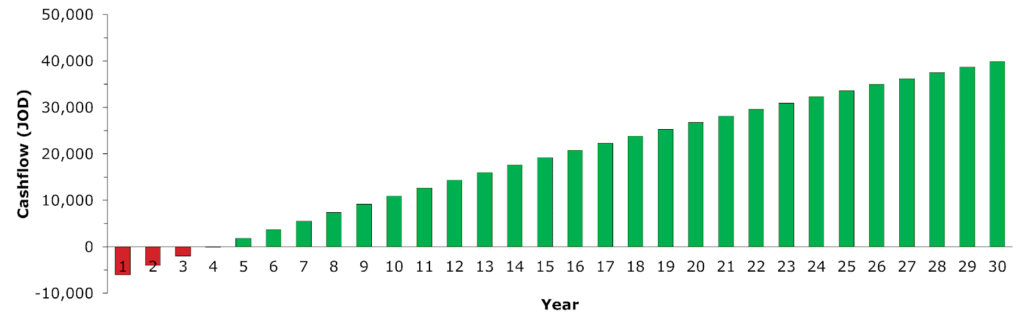
Numerous studies have investigated the benefits of the Passivhaus standard in Europe – demonstrating that homes designed and built to the standard can reduce the space heating demand by up to 78% compared to a typical new build. In terms of cost-benefit analysis, research has shown that the cost premium of homes built to the Passivhaus standard currently ranges from 4% to 8%, and is expected to fall over time and when implemented at scale. The estimated payback period of buildings designed to Passivhaus varies greatly and depends on numerous factors such as construction costs, government incentives, energy prices, and discount rates. Current estimates range from as little as 5 years to 25 years.
But is the Passivhaus concept viable in Jordan? Through this financial modelling exercise, we have attempted to estimate the cost premium of various design interventions required to achieve the Passivhaus standard, as well as the payback period of these measures. The results are encouraging: with an estimated construction cost premium of less than 5% (including our consultation fee), the payback period of a Passivhaus in Jordan would be approximately 6.5 years. Over a period of 15 years, the estimated cost savings can reach up to JOD 14,000. In addition to the known health and comfort benefits of Passivhaus, this exercise has shown that implementing Passivhaus in Jordan makes economic sense and could save homeowners up to JOD 35,000 over the lifetime of the house (30 years).
The key assumptions of this financial modelling exercise are as follows:
Gross Floor Area (GFA) of home: 1,000 m²
Construction cost, base case: JOD 500 per m² of GFA
Base case
Heating system: underfloor heating with Liquified Petrol Gas (LPG) as fuel. Capital cost: JOD 12,000. Annual operation cost: JOD 2,100 (based on an annual heating demand of 48 kWh/m²•year).
Insulation: 30 mm of Extruded Polystyrene (XPS). Cost: JOD 0.67 per m² of surface area.
Airtightness layer: None
Glazing: Double glass with aluminium frame (without thermal break). Cost: JOD 90 per m² of surface area.
Ventilation: exclusively natural
Improved case
Heating system: Electric resistance through Mechanical Ventilation Heat Recovery (MVHR) unit
Insulation: 300 mm of Extruded Polystyrene (XPS). Cost: JOD 6.7 per m² of surface area.
Airtightness layer: Covering entire envelope. Cost: JOD 1.5 per m² of surface area.
Glazing: Double glass with thermally-broken aluminium frame. Cost: JOD 150 per m² of surface area.