
But is the Passivhaus concept viable in Jordan? At Joule, we have conducted a preliminary study to assess the financial feasibility of applying the Passivhaus concept on a villa with a gross floor area of 1,000 m² in Jordan. The results show that the cost premium of adopting Passivhaus principles is as follows:
Thus, the total cost premium would be approximately JOD 24,869 – which represents 5% of the total construction cost of the villa (assuming an average construction cost of JOD 500 per m² of gross floor area).
In terms of benefits, the study shows that applying the Passivhaus concept achieves a net saving of up to JOD 94,769 in heating cost and JOD 11,180 in cooling cost over the course of the villa’s lifetime (30 years), with a payback period of less than 6 years*.
*Assuming a diesel boiler. The net savings vary according to the heating system adopted , the gross floor area of the building, and its architectural design.
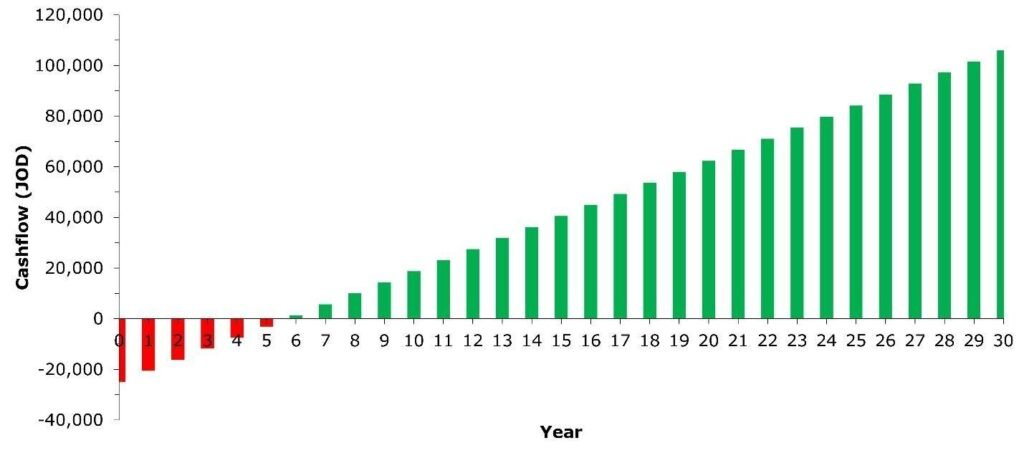
A graph showing the cost premium of applying the Passivhaus concept in Jordan along with the payback period. The graph demonstrates that the payback period is less than 6 years, with total net savings reaching up to JOD 105,946 by the end of the building’s lifetime (30 years).